

As a Concierge Integrative & Addiction Psychiatrist a large portion of my practice is with well-resourced individuals and families
. I’ve had the profound privilege of witnessing something that rarely makes it into boardrooms or estate planning meetings: the moment a family realizes their greatest inheritance isn’t measured in dollars, but in the capacity for wellbeing they pass from one generation to the next.
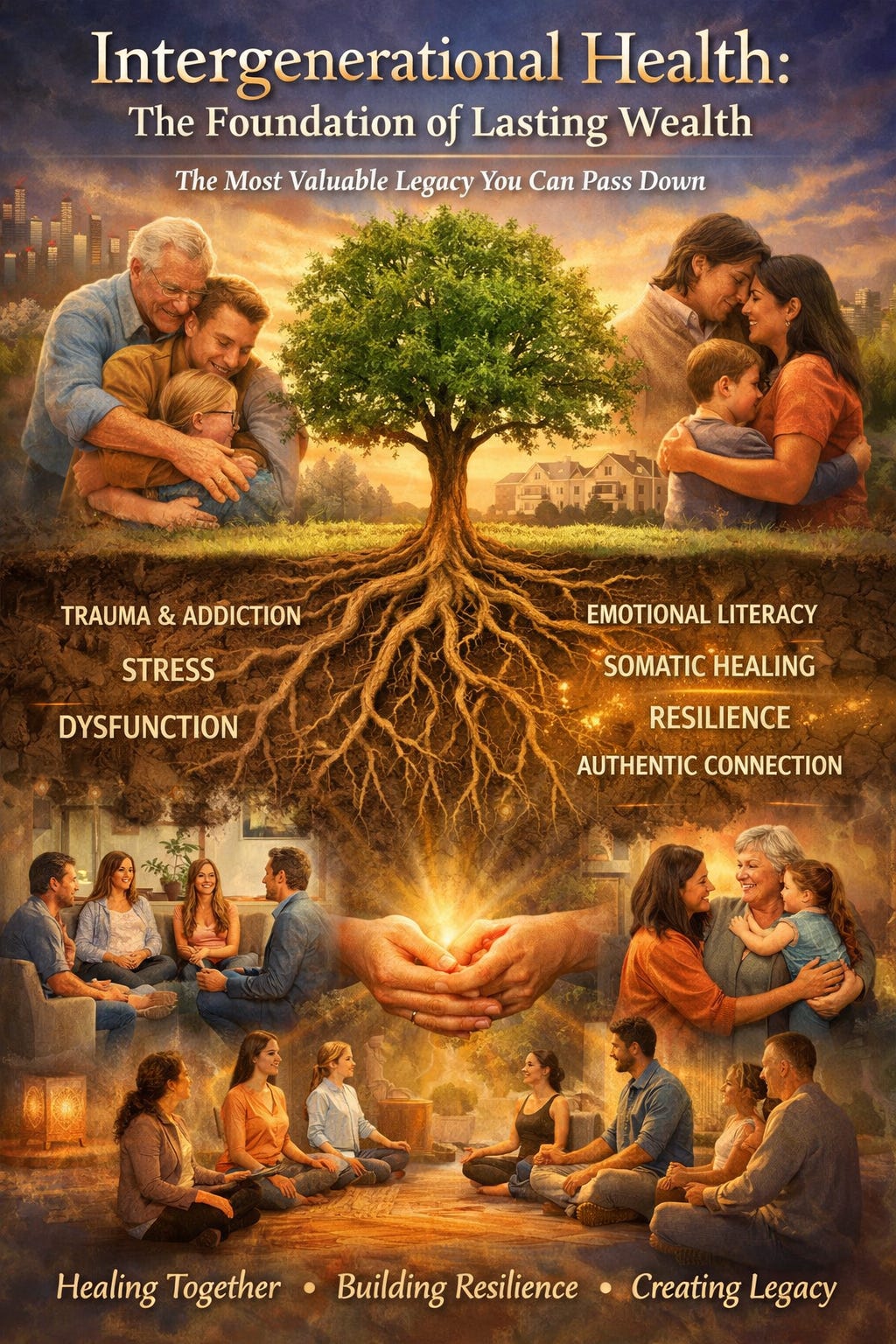
We talk endlessly about intergenerational wealth—the trusts, the portfolios, the real estate holdings, the family offices designed to preserve capital across decades. But what about intergenerational health? What about the patterns of resilience, the emotional literacy, the somatic awareness, and the capacity for authentic connection that either flourish or fracture as they move through family lines?
Here’s what I’ve learned sitting in living rooms across the United States and beyond: you can build the most sophisticated wealth preservation strategy in the world, but if you’re simultaneously passing down unresolved trauma, addiction, and dysfunctional coping mechanisms, you’re not building legacy—you’re building a beautiful house on a foundation of sand.
The Invisible Inheritance
When families come to me, it’s rarely framed as an intergenerational issue at first. A son struggling with substance use. A daughter with an eating disorder. An executive parent experiencing burnout and anxiety. The presenting problem feels individual, isolated.
A different pictures emerges, as we begin to work together making a shift to a family system rather than just treating the “identified patient.” We start to see the leak in the system, as I’ve written about before. That leak represents the place where generational trauma, unmet emotional needs, and learned maladaptive coping strategies flow across generations, having never been addressed with compassion.
In wealthy and well-resourced families, this dynamic often has a particular flavor. There’s the grandfather who built the empire through relentless work, perhaps medicating his stress with alcohol or infidelity, but calling it “unwinding.” There’s the parent who inherited both wealth and the belief that productivity equals worth, passing down the message that feelings are inconvenient and vulnerability is weakness. There’s the next generation, growing up with every material advantage, yet feeling profoundly empty, turning to substances or other destructive behaviors in a desperate attempt to feel something.
The family’s financial advisor can tell you exactly how much wealth has been preserved year over year. But who’s tracking the preservation of emotional capacity? Who’s measuring the family’s collective ability to sit with difficult emotions, to communicate authentically, to repair ruptures in relationship?
The Hidden Costs of The Unaddressed
Let me be clear about what I mean by intergenerational trauma. I’m not just talking about dramatic events, though those certainly count. I’m talking about the everyday ways that pain gets passed down through family systems—the chronic stress that becomes normalized, the emotional unavailability that gets mistaken for strength, the perfectionism that masquerades as excellence. What were once seen as strengths quickly become unbearable weights.
These patterns don’t just live in our thoughts and behaviors. We understand that trauma becomes encoded in the body itself as somatic memory. A parent’s chronic anxiety doesn’t just influence their parenting style, it creates physiological patterns that their children unconsciously mirror. The body learns to live in a constant state of hypervigilance or shutdown, and this becomes the baseline that the next generation inherits. On a physiological level, the chronic levels of stress hormones (i.e. cortisol) cause all kinds of other chronic conditions and inflammation.
I see this constantly in my practice. The executive who can’t sit still, whose body learned decades ago that stillness means danger and needs to chase dopamine and find comfort through behaviors that often lead to shame. The young adult who developed substance use issues because, as they often tell me, “it was the first time I felt the hug I needed.” These aren’t failures of willpower or moral character. These are adaptive responses to inherited nervous system dysregulation and unmet attachment needs.
And here’s the thing about wealthy families: the resources that should be protective factors—access to the best schools, the finest healthcare, unlimited opportunities—can actually mask these underlying patterns for years. The family can afford to send the struggling child to treatment centers, again and again. But if the family system itself hasn’t changed, if the emotional environment that contributed to the struggle remains the same, we’re not actually healing anything. We’re just managing symptoms. The mindset that sending someone away and expecting everything to be fixed is the source of the problem.
Reframing the Conversation
In my work with families, I’ve moved away from the traditional intervention model in which everyone gathers to confront the person “with the problem.” Instead, I frame our work together as an invitation for the entire system to heal. I bring in my colleagues with their own lived experiences and expertise to blend a welcoming support system. This shift is everything. It moves us from blame to curiosity. From “What’s wrong with you?” to “What happened to us?” From individual pathology to collective growth.
When I work with a family dealing with addiction, for example, we don’t just focus on the person using substances. We look at the entire family’s relationship with stress, with emotions, with epigenetic patterning, with connection and disconnection. We examine the unspoken rules that govern family life: Don’t talk about difficult things. Don’t show weakness. Success is the only acceptable outcome. Your worth is determined by your productivity and at times your appearance.
These rules, often passed down unconsciously from previous generations, create the conditions where addiction, chronic health conditions, and other mental health struggles can take root. And here’s what I’ve discovered: when family members who initially thought they were just “supporting” their loved one begin to address their own emotional needs, their own relationship with stress and coping, their own unresolved experiences is when sustainable healing becomes possible.
Studies on family-inclusive therapy consistently show higher success rates for individuals in recovery. More than that, they show something profound: when families heal together, they create resilient systems that can navigate future challenges. They’re not just fixing a problem; they’re building capacity for wellbeing that will serve multiple generations.
The Somatic Dimension: Healing the Body, Healing the Line
One aspect that’s often overlooked in conversations about family mental health is the somatic dimension. By this I refer to the ways that trauma and stress patterns live in our bodies and get passed down through modeling and epigenetic mechanisms.
I often work with families where there’s been no explicit trauma (i.e. no abuse, no major losses), yet everyone carries this palpable tension in their bodies. Tight shoulders. Shallow breathing. Chronic digestive issues. Autoimmune conditions. Difficulty sleeping. These are the body’s ways of holding stress that was never fully processed, often across multiple generations.
When families are taught to bring somatic awareness then begin to notice what’s happening in their bodies, to name sensations, to develop practices that help regulate their nervous systems and this is when we’re literally changing the inheritance. We’re teaching skills and resources that will get passed down instead of dysregulation.
This is where integrative practices become so valuable. Breathwork. Movement. Sleep. Nutrition that supports mental health. Mindfulness practices. These aren’t luxuries or “extras,” they are the foundational tools for building intergenerational wellness. And in my experience with families who have resources, there’s incredible potential here. The same resources that built financial wealth can be redirected toward building health wealth.
The Role of Commitment and Unconditional Love
Healing addiction and trauma within a family system requires something that money can’t buy: genuine commitment from everyone involved. And this commitment isn’t about fixing or rescuing the identified patient. It’s about each family member looking inward, acknowledging their own emotional inheritance, and committing to their own growth.
True support isn’t about control or enabling. It’s about creating a foundation of unconditional love and stability while also maintaining healthy boundaries. It requires the kind of vulnerability that makes people uncomfortable. It demands that parents, uncles, aunts, grandparents acknowledge their own struggles and limitations. It asks siblings to stop playing their assigned roles and discover who they actually are.
This is hard work. It’s much easier to write a check for another treatment program than to examine your own relationship with substances, stress, or emotions. It’s more comfortable to focus on the struggling family member than to acknowledge the ways the whole family might be struggling.
What here is what I’ve been humbled to witness time and again: when families make this commitment, when they choose to heal together rather than trying to fix one person, something profound shifts. The person who was struggling doesn’t just get “better,” they discover that they’re part of a family that’s choosing evolution over repetition. And that changes everything.
Building Wealth That Actually Lasts
So what does it mean to build intergenerational wealth that truly lasts? It means recognizing that financial capital is only one form of wealth, and arguably not even the most important form.
Real intergenerational wealth includes:
Emotional literacy – the ability to name, understand, and work with the full range of human emotions rather than suppressing or avoiding them.
Somatic awareness – understanding the body’s wisdom and having practices to regulate the nervous system and process stress.
Relational capacity – the ability to form secure attachments, communicate authentically, repair ruptures, and maintain connection even through conflict.
Adaptive coping mechanisms – healthy ways to manage stress and difficult emotions that don’t cause harm to self or others.
Narrative coherence – understanding your family’s story, including the difficult parts, and being able to make meaning from experience rather than repeating unconscious patterns.
Collective resilience – the capacity of the family system as a whole to navigate challenges, support individual growth, and maintain connection across generations.
These forms of wealth don’t depreciate over time, they compound. A grandparent who does the work to address their own trauma doesn’t just help themselves; they change what gets passed to children and grandchildren. A parent who learns to regulate their nervous system gives their child a different template for managing stress. A family that creates space for authentic emotional expression builds a different kind of safety that will echo through generations.
The Privilege and Responsibility
Working with well-resourced families, I’m acutely aware of both the privilege and the responsibility involved in this work. The privilege is obvious: these families have resources that make healing work accessible in ways that aren’t available to everyone. They can afford time, space, and expert support.
But there’s also a profound responsibility. These families have the opportunity to model something different, not just for their own descendants, but for the broader culture. When a wealthy family publicly or privately commits to intergenerational healing, when they acknowledge that all the financial success in the world doesn’t protect against mental health struggles, when they invest as thoughtfully in family wellness as in wealth preservation, they help shift the conversation for everyone and create space for vulnerability.
Many of the families I work with are thinking about their legacy differently. Instead of just asking “How do we preserve our wealth?” they’re asking “How do we raise generations of humans who are emotionally healthy, relationally connected, and resilient in the face of life’s inevitable challenges?” This is the conversation we need more of.
The families who do this work don’t just change their own trajectories. They change what’s possible for generations to come. They pass down emotional capacity instead of emotional debt. They give the gift of secure attachment instead of anxious striving. They model that wealth is something you are, not just something you have.
This is the work of building legacy that actually matters. Not just preserving capital, but preserving and expanding the capacity for human flourishing. Not just protecting assets, but protecting and nurturing the health of the family system itself.
The Invitation
If you’re reading this and recognizing your family in these patterns, I want you to know: the leak can be repaired. The inheritance can change. It’s not too late and it’s never too early to begin this work.
Start by getting curious instead of judgmental. Instead of asking “What’s wrong with this person?” ask “What’s happening in our system?” Instead of focusing solely on symptoms, look at the soil those symptoms are growing in.
Consider bringing in support that understands family systems, trauma, and addiction not as individual pathologies but as systemic issues. Look for practitioners who will work with the whole family, not just the identified patient.
Most importantly, examine your own relationship with stress, emotions, substances, work, and connection. The most powerful thing any family member can do is commit to their own healing journey. That commitment ripples through the entire system.
At the end of the day, you can leave your children every material advantage in the world. But if you also leave them with unresolved trauma, with bodies that don’t feel safe, with an inability to connect authentically or regulate their emotions—what kind of inheritance is that, really?
The invitation is clear: intergenerational health is intergenerational wealth. And unlike financial markets, it’s an investment that always yields returns when approached with genuine commitment, unconditional love, and the courage to heal together.
Much Love & Gratitude,
~Dr. A