
Stop Passing the Wound Forward
Learning through challenge, attachment, and the path to wholeness

Carl Jung wrote about the shadow as the hidden life of the psyche, the parts of ourselves that don’t make it into the light. In the corridors of childhood, when a child encounters pain they don’t yet have the language or the nervous system capacity to hold and those unmet moments don’t disappear. They go underground. They become shadow.
The psyche is always searching for wholeness. However, when wholeness feels inaccessible, when comfort is absent, when big feelings arrive without a steady hand nearby; a child learns to reach for something else. Over time that reaching can become the foundation of addiction. It is not a moral failing, but instead it is a nervous system doing exactly what it was designed to do: find relief.
At the center of all of this is a deceptively simple need. Safety. From the very beginning of life the nervous system is scanning below conscious awareness for the presence of a regulated caregiver. Someone who says, with their body if not their words: you can feel this, and you will survive it. That co-regulation is not a luxury. It is the biological foundation upon which resilience is built.
A child moving through pain while a parent remains close and calm learns something that no curriculum can teach: that hard things are survivable. That big feelings have edges. That they will come back to themselves on the other side. This is about accompanying them through difficulty and not shielding them.
In my clinical work, I’ve moved away from the Westernized reflex toward diagnostic labels and have instead learned to attune to what the nervous system in front of me is communicating. What is happening beneath the surface? How does that dysregulation shape the psyche? How does it reach into the spirit?
The symptoms whether they be physical pain, energy depletion, apathy, brain fog, mood fluctuations, or sleeplessness are not disorders, but instead are memos. They are dispatches from the body asking to be heard. They are the unspoken voices from the fascia, from the intricate architecture of the body, from years of accumulated experience living just below awareness. They are asking, in the only language the body knows, for comfort and safety.
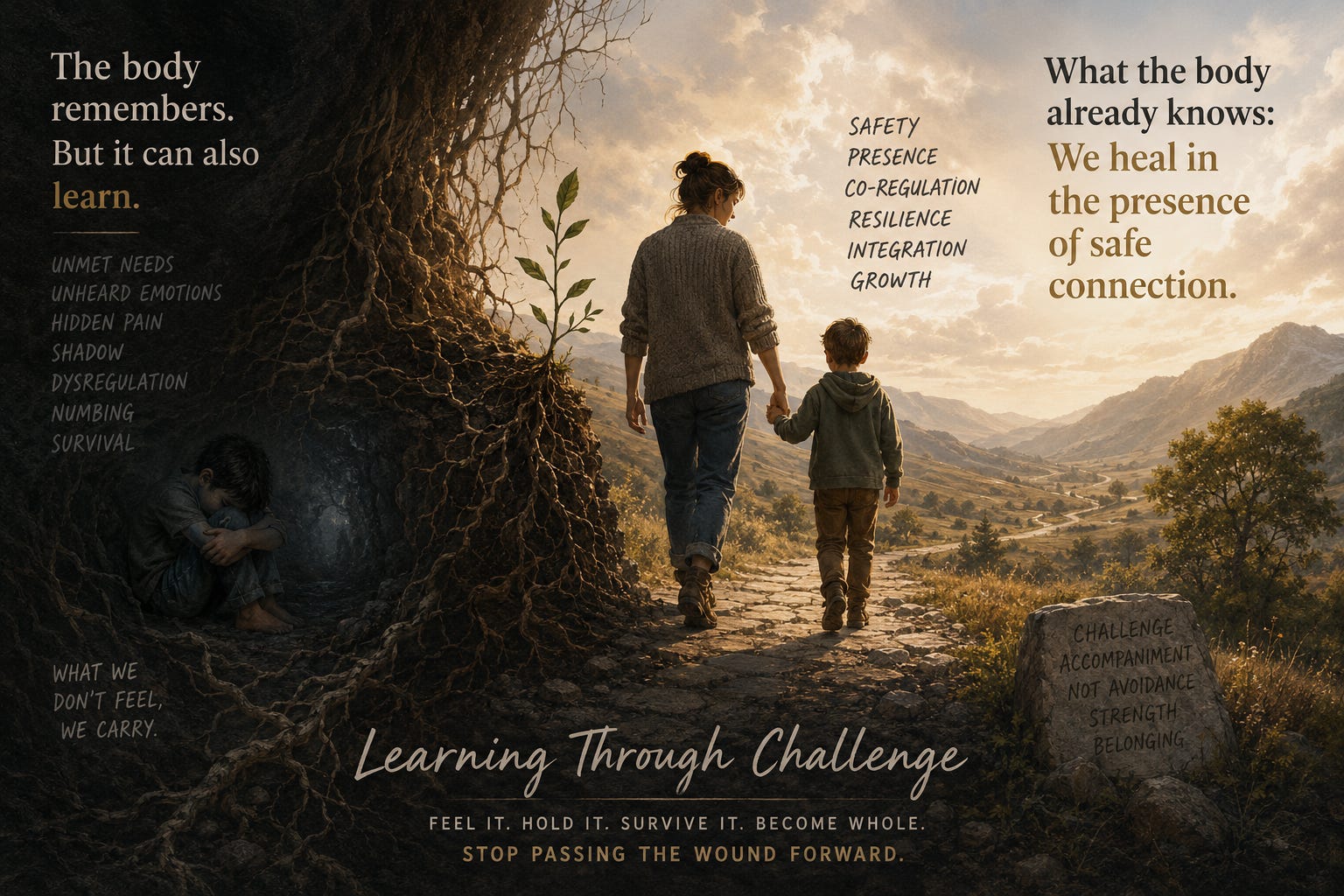
Treatment, then, begins with listening. Not fixing. Listening and feeling. Tuning into what is being held, so that the real work of healing can begin.
The tragedy of modern life is that we have become strangers to our own nervous systems. We were never taught to read these signals. Hence, when they arise, as they always arise, we don’t know what to do with them. And as they grow louder and more insistent, the impulse is to silence them: to reach for the phone, the drink, the vape, the numbing scroll, the relationship that keeps us just distracted enough not to feel what’s underneath.
We anesthetize rather than attend.
This is a cultural failing. We were not taught how to respond. And many of us were raised by people who were not taught either. This is how pain travels. Not just through genetics, but through the silences, the avoidances, and the topics that were never named out loud.
We can do better. And the place to start is with children.
It starts not by engineering a childhood free of difficulty as that approach does its own quiet harm, sending children into adulthood without the lived knowledge that they can face hard things. But by creating what I’d call safe containers: environments where difficulty is met, not avoided; where children are accompanied through struggle rather than protected from it. These are the spaces I work to create with the patients and families I have the honour of sharing space with.
Many parents, driven by love, work tirelessly to alleviate hardship for their children. They work by shielding them from hard conversations, absorbing the weight of generational pain, quietly smoothing the road ahead. This does not come from a harmful or malicious place. And yet, in the end, it can become a quiet failure that often times leaves the child unprepared, with a nervous system that hasn’t yet learned it can survive the obstacles life will inevitably bring. What often follows is disorienting for everyone involved. The child, now facing a world they weren’t equipped for, doesn’t always have the language or the self-awareness to understand why. And so, the emotion lands somewhere familiar: on the parent. Resentment. Anger. Blame. Not because the parent deserves it, but because the gaze has always gone toward the one who was supposed to prepare them.
There is a painful irony here. The abundance of resources, the removal of friction, the careful clearing of every obstacle can quietly work against the very child it was meant to protect.
When a child knows there is a steady presence nearby and that they won’t be abandoned in their pain, their nervous system learns to regulate. The psyche learns that it can integrate hard experience rather than exile it to the shadow. That learning becomes the foundation of everything: emotional resilience, relationship capacity, the ability to sit with discomfort rather than run from it.
The hard conversations we avoid today don’t disappear. They simply wait for the next generation to inherit them.
It is time to stop passing the wound forward.
Peace,
~Dr. A